Big cities gain 18-year-olds and lose 20-somethings, Bristol aside
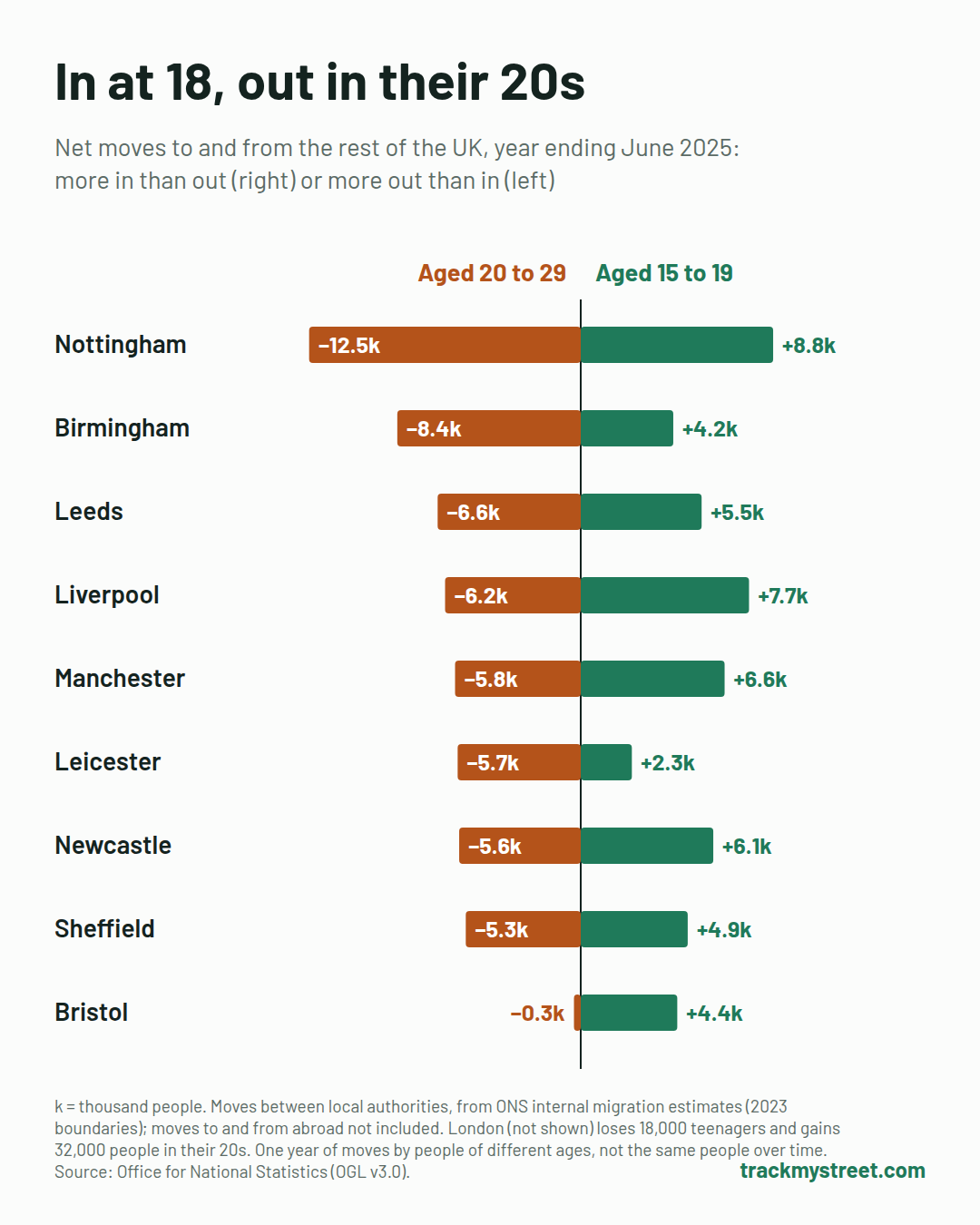
England's big university cities each draw in thousands of teenagers a year from the rest of the UK, most of them students. Nearly all then lose more people in their 20s than they gain, and Bristol is the one that comes close to holding on to them.
Published
Nottingham: a city that fills up at 18 and empties at 22
Think of a Nottingham street in September: removal vans, new students, parents with boxes. In the year to June 2025, about 8,800 more 15 to 19-year-olds moved to Nottingham from elsewhere in the UK than left it, the most of any big city.
In people's early 20s, the flow turns. Nearly two people in their early 20s left Nottingham for every one who moved in. Across their 20s, the city lost about 12,500 more than it gained.
Bristol: as many arrive in their 20s as leave
Bristol gains fewer teenagers, about 4,400 more in than out. But it keeps its 20-somethings far better than any other big city.
In their early 20s, about 13,500 people moved to Bristol and almost exactly the same number left. Across all their 20s, the city lost only about 300 more than it gained.
Birmingham and Leicester: more leave in their 20s than ever arrived
In Birmingham and Leicester the loss in people's 20s is two to two and a half times the gain in their teens. Part of the reason is at the start: these cities also see more of their own teenagers leave, about 5,200 from Birmingham.
Leeds and Sheffield lose a little more in their 20s than they gain in their teens. Manchester, Liverpool and Newcastle upon Tyne lose eight or nine for every ten they gain. A 2019 study found just over half of Manchester's graduates stayed in the city after university, second only to London (Centre for Cities, 22 March 2019).
London: where the early 20s go
London is the mirror image. It loses about 18,000 more teenagers than it gains. Then it gains about 30,000 more people in their early 20s than it loses.
By their early 30s, Londoners are leaving again: the capital lost about 26,000 more people aged 30 to 34 than it gained.
What this means for you
- Choosing a university? Most big university cities lose more young people than they keep once study ends. If you hope to stay and work in the city, look at what jobs and rents it offers people in their 20s, not just students.
- Writing about a local "brain drain"? Compare a city's gain at 15 to 19 with its loss at 20 to 29. A big loss in the 20s can simply follow a big student intake.
How we did this
We used ONS's internal migration estimates for the year ending June 2025: moves into and out of each local authority from elsewhere in the UK, by five-year age group (on 2023 boundaries). The 20s figure adds the 20 to 24 and 25 to 29 age groups. Nottingham: 15 to 19 net +8,835; 20 to 24 net −10,102 (11,670 in, 21,772 out); 25 to 29 net −2,370. Bristol: +4,432, −20 and −291. London's figures add up its 33 local authorities, so moves between boroughs cancel out.
This is one year of moves by people of different ages, not the same people followed over time. It doesn't count moves to or from abroad, so international students and graduates who leave the UK aren't in it. Net international migration fell sharply in that year, driven by fewer people arriving from outside the EU to work and study (ONS, 27 November 2025). Age is not the same as being a student or a graduate. England & Wales cities only.
Check your area
See who is moving in and out of your council area on the Big Picture map at trackmystreet.com/uk.
Data
- Internal migration by local authority, age and sex, year ending June 2025: Office for National Statistics (Open Government Licence v3.0)
Changes to this article
- 2026-11: first published.