At today's rates, buying beats renting in just 1 of 10 big cities
A first-time buyer with a 10% deposit faces mortgage rates of about 6%. At that rate, the monthly repayment on the typical home sold is below the average private rent only in Newcastle upon Tyne, though buying a flat costs less a month than renting one in five of the cities.
Published
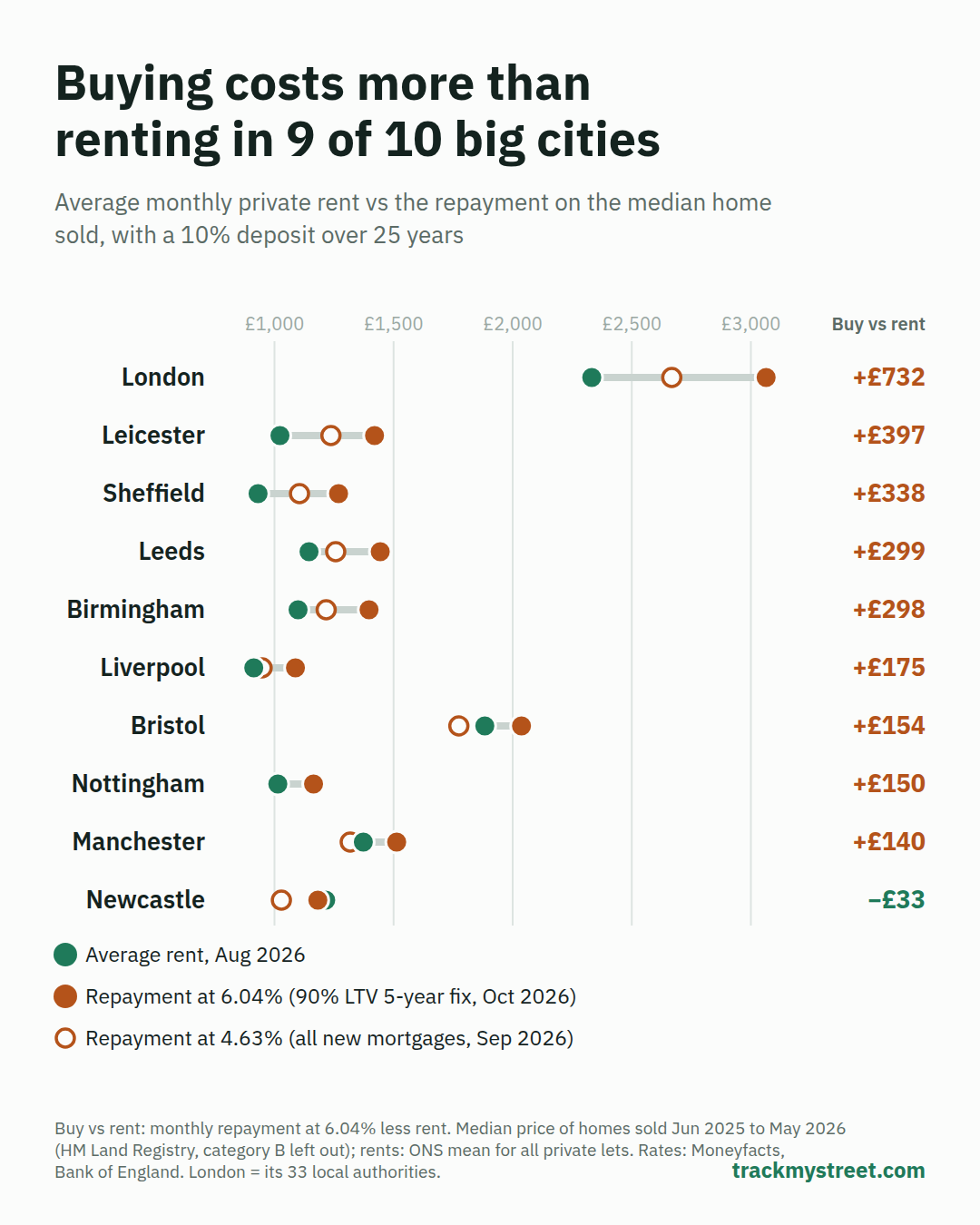
Newcastle is the exception
The median home sold in Newcastle upon Tyne from June 2025 to May 2026 cost £203,000. With a £20,300 deposit and a 25-year mortgage at 6.04%, the repayment is £1,182 a month. The average private rent there was £1,215 in August 2026, so buying costs £33 a month less.
6.04% is Moneyfacts' average five-year fix at 90% loan-to-value in October 2026, up from 5.70% in September (Moneyfacts, 19 October 2026).
Leicester, Sheffield and London: the widest gaps
Buying costs most next to renting in Leicester: £1,420 a month on a £244,000 home, against a rent of £1,023, a gap of £397. Sheffield follows at £338. In London the median home cost £526,000; the repayment of £3,064 is £732 above the average rent of £2,332, and the deposit alone is £52,600. No London borough comes out cheaper to buy. Tower Hamlets is closest, at £380 a month more.
A lower rate changes the picture
Borrowers as a whole paid less. The effective rate on newly drawn mortgages was 4.63% in September 2026 (Bank of England, 29 October 2026). At 4.63% buying also costs less in Bristol (£109 a month), Manchester (£55) and Newcastle (£186), and Nottingham comes out level. It is an average across all new mortgages, so treat it as a best case for a buyer with a 10% deposit.
Flats: cheaper to buy in five cities
The median home sold is usually a house, while many renters live in flats. Comparing flats with flats at 6.04%, buying costs less a month in Newcastle (£896 against a flat rent of £993), Leicester (£716 against £799), Birmingham (£856 against £919), Nottingham (£786 against £837) and Leeds (£873 against £905). In London a flat still costs £447 a month more to buy than to rent.
Rents are still rising: the UK average rose 3.8% in the 12 months to September 2026, while London house prices fell 2.2% in the 12 months to August, driven by flats (ONS, 21 October 2026).
What this means for you
- The deposit is the real barrier. In most cities the monthly gap is a few hundred pounds, but the deposit is £18,700 to £35,000, and £52,600 in London.
- Compare like with like. A flat in Birmingham or Leeds can cost less a month to buy than to rent. A house usually costs more.
- A bigger deposit helps twice. It cuts the loan and the rate: in October 2026 Moneyfacts' average five-year fix was 6.30% at 95% loan-to-value and 5.60% at 60%.
How we did this
We took the median price of every home sold from June 2025 to May 2026 (HM Land Registry, category B sales left out), by 2023 local authority; London is its 33 local authorities. Later months are left out as many sales are still being registered. The repayment is on 90% of that price over 25 years. Rents are ONS's average (mean) for all private lets in August 2026, sitting tenants included, so they are below asking rents on new lets.
This compares repayments with rent only. It leaves out stamp duty, fees, service charges, maintenance and the interest a deposit could earn, and holds the rate for 25 years. Shared ownership part shares are counted as sales. England & Wales only.
Check your area
See sale prices and rents for your own area on the map at trackmystreet.com/uk.
Data
- Price paid data, Jun 2025 to May 2026: HM Land Registry (Open Government Licence v3.0)
- Price Index of Private Rents, Aug 2026: Office for National Statistics (Open Government Licence v3.0)
- Average 90% LTV five-year fixed rate, Oct 2026: Moneyfacts
- Effective rate on newly drawn mortgages, Sep 2026: Bank of England
Changes to this article
- 2026-11: first published.